

Join us when the WASP community come together for the most appreciated event of the year!
Welcome to the Winter Conference 2026!
Dates: January 13-15
Location: Conventum, Örebro
Conventum is located just across the park from the train station Örebro Södra.
The facility consists of three linked buildings, Conference, Congress and Arena, and we will use all of them during different parts of the program.
Click on the map to enlarge (opens in a new tab).
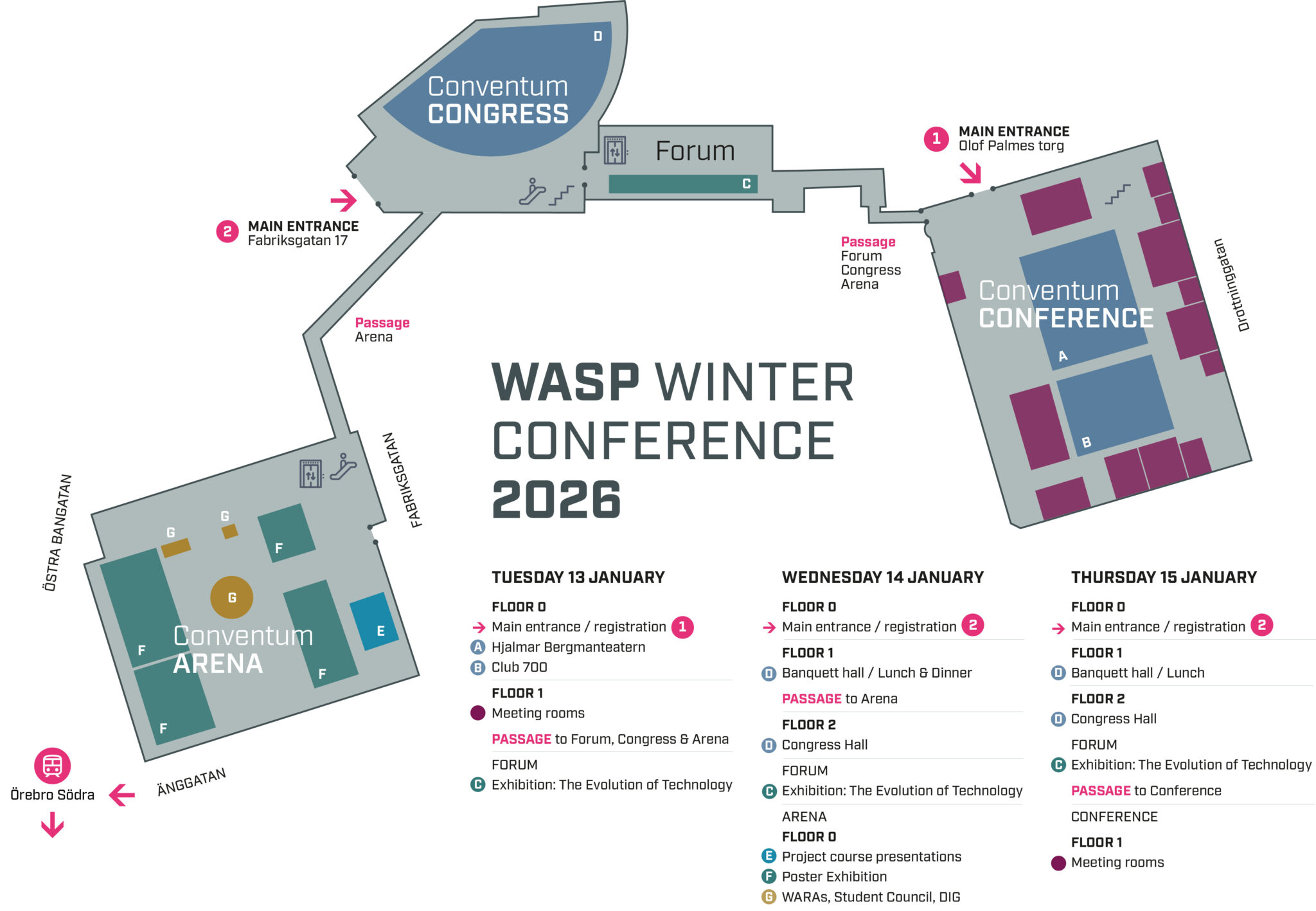
Map Conventum, all buildings
Questions? Please reach out to WASP Program Office.
Registration
The registration is closed.
Program overview
January 13
Pre-conference to welcome new PhD students and their supervisors.
PhD students who started in 2025 or will start in January 2026 and their supervisors are invited. Attendance is mandatory for PhD students and optional for supervisors. It is recommended if you are new as supervisor in WASP.
January 14-15
Main conference where the whole WASP community is invited.
This year we expect more than 600 people from the WASP community to join for program updates, research presentations, poster sessions and cluster meetings. There will also be awards and a ceremony for our 2025 graduates.
The main conference is mandatory for all PhD students and exceptions to attend must be approved by your supervisor.
Keynote speakers
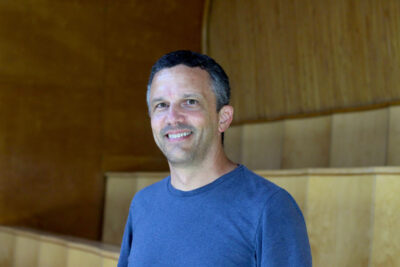
Serge Belongie
Title of talk: Generative AI & Magical Thinking
Bio
Serge Belongie is a professor of Computer Science at the University of Copenhagen, where he also serves as the head of the Pioneer Centre for Artificial Intelligence (P1). Previously, he was a professor of Computer Science at Cornell University, an Associate Dean at Cornell Tech, a member of the Visiting Faculty program at Google, and a professor of Computer Science & Engineering at UC San Diego.
His research interests include Computer Vision, Machine Learning, Augmented Reality, and Human-in-the-Loop Computing.
Read more: https://sergebelongie.github.io/
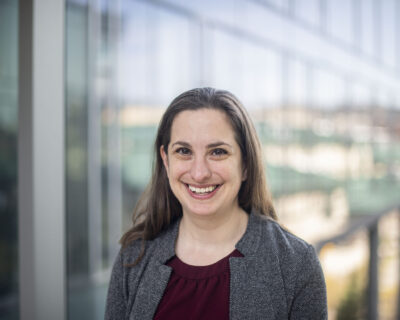
Henny Admoni
Title of talk: The Role of Humans in AI and Robotics
Bio
Dr. Henny Admoni is an Associate Professor in the Robotics Institute at Carnegie Mellon University, where she leads the Human And Robot Partners (HARP) Lab. Dr. Admoni’s research interests include human-robot interaction, assistive robotics, and nonverbal communication. Dr. Admoni holds a PhD in Computer Science from Yale University, and a BA/MA joint degree in Computer Science from Wesleyan University. In 2024, she was a WASP Guest Researcher at KTH.
Read more: https://hennyadmoni.com/bio/
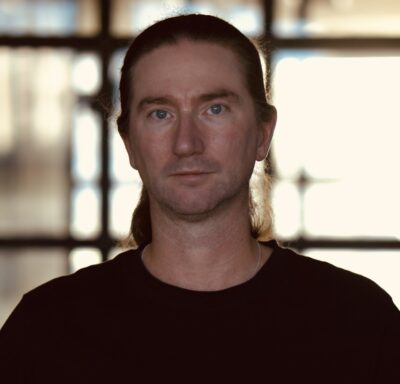
Adam Tornhill
Title of talk: Next-Gen Software Development: AI Acceleration Without the Chaos
Bio
Adam Tornhill is a programmer who combines degrees in engineering and psychology. He’s the founder of CodeScene, where he designs tools for software analysis. He’s also the author of the best-selling Your Code as a Crime Scene, and three more technical books. Adam’s other interests include music, retro computers, and martial arts. In this talk, Adam shares his experience safeguarding AI rollouts in real production systems.
Read more: https://www.adamtornhill.com/
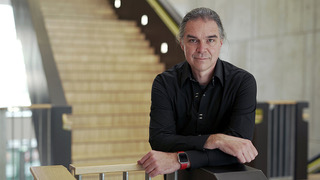
©Humboldt-Stiftung_Elbmotion
Holger H. Hoos
Title of talk TBA
Bio
Holger H. Hoos holds an Alexander von Humboldt Professorship in AI at RWTH Aachen University (Germany), where he also leads the RWTH AI Center. Holger’s
research is aimed at methodological and technological advances in human-centred AI, AI for Good and AI for All. Specifically, he seeks to improve the efficiency of AI methods, by automatically increasing performance and reducing resource needs; and to broaden access to and use of cutting-edge AI methods. Overall, Holger and his group develop and study AI methods that augment rather than replace human intelligence, and that help human experts to overcome their biases and limitations.
Known for his work on machine learning and optimisation methods for the automated design of high-performance algorithms and on stochastic local search, Holger has developed – and vigorously pursues – the paradigm of programming by optimisation (PbO); he is also one of the originators of the concept of automated machine learning (AutoML). Holger has a penchant for work at the boundaries between computing science and other disciplines; much of his work is inspired by and has broad impact on real-world applications.
Read more: https://hoos.ca/main.html
